Pick Three, Then Commit: A Switch Trial for People Who Actually Type
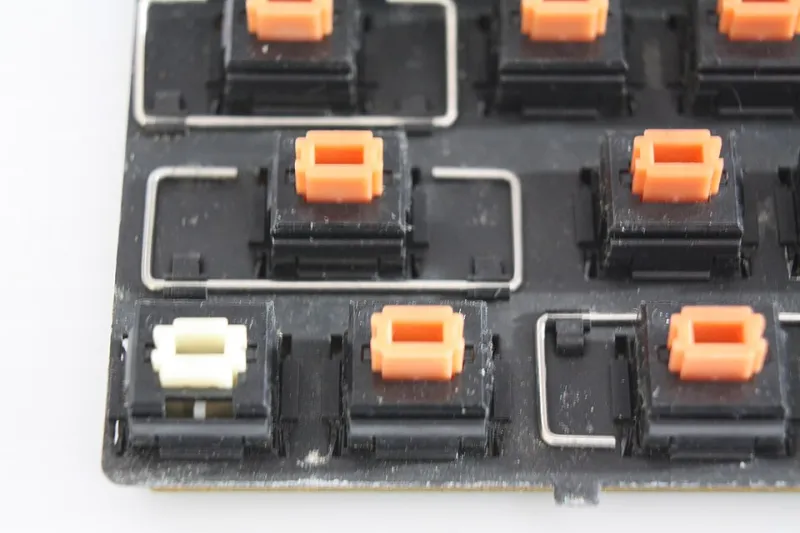
Photo: snuci, Public domain, via Wikimedia Commons
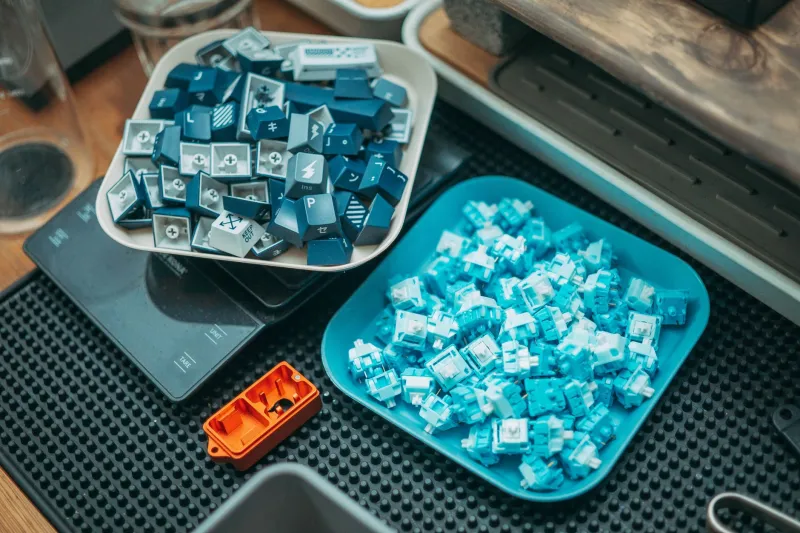
Switch samplers have a way of becoming tiny museums. You buy one to answer a simple question—what do I like?—and six months later you have a plastic tray of loose switches, a spreadsheet with color codes, and no clear favorite. The problem is not that samplers are useless. The problem is that a sampler lets you compare dozens of switches in a context that has almost nothing to do with your actual keyboard.
A switch in a acrylic tester with no keycaps, no plate, and no case is a demo. A switch in your board, under your fingers, at your desk, during a normal Tuesday of email and spreadsheets, is a decision. The difference matters.
The sampler trap
Most switch shopping starts with volume. More samples feels like more information. In practice, a big sampler pushes you toward novelty: the smooth one, the snappy one, the weird one, the one that sounds like a bubble wrap factory. You end up ranking switches by how interesting they are for thirty seconds, not by how they feel after thirty minutes.
That is how people end up with a drawer of loose switches and a daily driver they are still not sure about. The hobby rewards collecting, but your keyboard rewards consistency. You need a test that produces a verdict, not another wish list.
The three-switch rule
Here is the rule: test exactly three candidates at a time. One linear, one tactile, and one wildcard—either a silent switch or a notably heavier option. That is it. Three switches, one board, one week. The goal is not to crown the ultimate switch. The goal is to eliminate two candidates with evidence and keep the one that survives real work.
Why three? Because two feels like a coin flip, and four or more turns into a sampler again. Three gives you contrast without chaos. The linear shows you smoothness and spring behavior. The tactile gives you a bump to push against. The wildcard tests a specific tradeoff: silence for shared spaces, or weight for heavy-handed typists who want to stop bottoming out. You are not building a collection. You are running a short, fair trial.
Choose your trio like a concierge
Start with what your board already tells you. If you have been using linears and wondering about tactiles, do not test five tactiles. Pick one linear you know, one tactile that gets consistent praise for a moderate bump, and one silent switch if you work near other people. If you have a heavy hand and keep mashing the space bar, make the wildcard a heavier spring rather than a silent switch.
A few practical filters:
- Compatibility first. Make sure all three candidates fit your board’s plate and PCB—especially if you are using a hot-swap board. Three-pin and five-pin matter.
- Same keycaps, same board. Do not test one switch under ABS cherry profile and another under tall SA caps. That is not a switch test; that is a keycap test with extra steps.
- One variable at a time. If you are testing weight, keep the travel and housing material as close as you can. If you are testing sound, keep the desk mat and room the same.
- Label the switches. Put a tiny piece of tape on the underside of each keycap or use a keycap puller and a labeled bag. You will forget which is which. Everyone does.
Run the test in your actual room
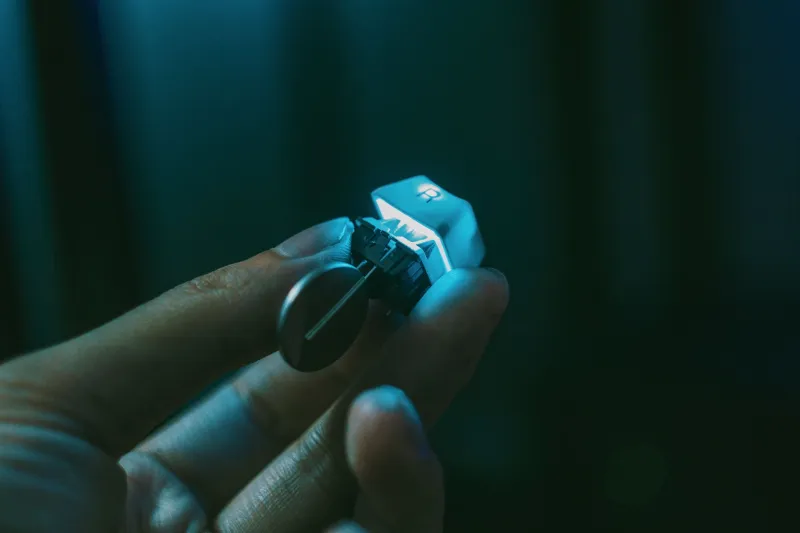
This is the part samplers cannot give you. Install all three switches in the same board—ideally in the same row or in three keys you use constantly, like H, J, and the space bar area. Then type. Not for thirty seconds. For a real block of work.
Use a twenty-minute test loop:
- Five minutes of normal typing. Email, notes, a document. Do not perform for the switch. Type the way you actually type.
- Five minutes of hard typing. Fast bursts, numbers, shortcuts, a paragraph you know by heart. This is where spring weight and bottom-out behavior show up.
- Five minutes of quiet work. If you share a room, this is the silent-switch reality check. If you do not, listen for ping, rattle, or housing crunch in your case.
- Five minutes of fatigue check. Keep typing, but pay attention to your fingertips, knuckles, and forearms. A switch that feels exciting for five minutes can feel scratchy or heavy by minute twenty.
Do this for three or four days. Your first impression is useful, but your fourth-day impression is the one that pays rent.
A scorecard that forces a decision
Keep it simple. Rate each candidate from 1 to 5 on four categories, then write one sentence of evidence. A score without a note is just a vibe.
| Category | What to listen for | Score (1–5) | Evidence |
|---|---|---|---|
| Spring weight | Does it return cleanly? Do you bottom out constantly? | ||
| Tactility | Is the bump informative or just noisy? Does it slow you down? | ||
| Sound | In your case and room, is it pleasant or distracting? | ||
| Fatigue | After twenty minutes, do your fingers want a break? |
At the end, do not average the scores. Look for the candidate with the fewest real complaints. A switch that scores 4s across the board but has one nagging issue—scratchiness, a hollow sound, a spring that feels heavy on your pinky—is usually a worse daily driver than a switch with a couple of 3s and no dealbreakers.
Fatigue is the tiebreaker
Most switch reviews obsess over sound and smoothness because those are easy to capture on video. Fatigue is harder to show, but it is the most important long-term data point. A heavy tactile might feel fantastic for a paragraph and miserable by the end of a workday. A silent linear might sound dead in a demo and feel perfect in a shared office.
Pay attention to the small stuff: Does your space bar thumb feel tired? Are you missing keystrokes because the bump is too sharp? Does the sound make you tense? Those are not nitpicks. They are the reason you are testing in the first place.
Decide, then close the drawer
After a week, pick one. Install a full set. Use it for a month before you allow yourself to shop again. If the winner disappoints, you still learned something specific—too heavy, too light, too noisy, not enough feedback—and your next three-switch trial can be sharper.
The point of the three-switch rule is not to make switch shopping joyless. It is to keep the joy in typing. A sampler can teach you what exists. Your own board can teach you what works. Pick three, test them honestly, write it down, and commit. Your fingers will thank you, and your switch drawer will finally stop growing.