Profile Wars Are a Waste of Time: Fit Your Hands, Then Pick a Keycap Shape
Photo: Patrick Breen, CC BY 2.0, via Wikimedia Commons
Ask five keyboard people about keycap profiles and you will get four religions and one guy who insists it is all marketing. It is not marketing. It is also not a moral position. Profile is a fit problem, and it has a right answer for your hands, your desk, and the keys you actually press all day.
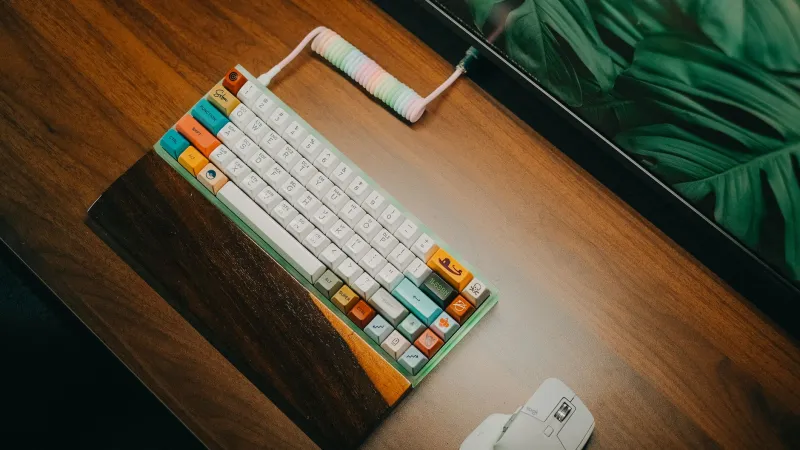
The trouble is that profile discussions tend to start at the wrong end — with a brand, a group buy, or a photograph of a board with a beautiful gradient set on a walnut wrist rest. Start with your hand instead.
What a Profile Actually Changes
Four things, and only four, decide how a set feels under your fingers.
Row sculpt. Whether each row has a different height and angle, or whether every cap is shaped the same. Sculpted sets differ top to bottom; uniform sets do not.
Overall height. Some profiles sit tall and proud, others hug the plate. Height changes how far your fingers travel between rows and how much air is trapped in the case underneath.
Top surface shape. Dish depth, corner radius, and top area. A deep, scooped top grabs a fingertip. A wide, flat top encourages sliding between keys.
Thickness and material. Thick PBT and thin ABS change the sound as much as the shape, but they do not change the fit. Keep them separate in your head or you will misattribute what you feel.
That is the entire map. Everything else is branding.
Sculpted Profiles: What They Are Good At
Sculpted sets angle the rows so your fingers land more or less where they would if you cupped your hand over an invisible ball. On a standard home row, this is comfortable. The dish on F and J tells you where you are without looking.
The trade shows up at the edges of the board. Tall, aggressively sculpted profiles make the number row and the F-row feel like a different zip code on a full-size keyboard, especially for shorter fingers or anyone with a smaller hand span. Cherry-style sculpt is gentler than something tall and heavily angled, and that difference matters more than most reviews admit. If you routinely reach for 1 through 5 or the function row, sit down at a board with tall caps before you buy. Your reach is not negotiable; the caps are.
Uniform Profiles: When the Same Height Wins
Uniform sets keep every row identical, and that earns them a bad reputation among people who have never used a keyboard with a macro column, a split layout, or an aggressive negative tilt. On a flat board angled slightly away from you, a uniform profile keeps every row at a consistent reach. On a split keyboard with thumb clusters, uniform caps make the thumb keys usable in any orientation. On a 40 percent board where half your punctuation lives behind a layer, uniform is often simply faster, because your muscle memory is not fighting a height change every time you move a row.
They are also the friendlier choice for people who rest their wrists on the desk and use their whole arm to move between zones rather than planting a hand and stretching.
The Shortcut Problem Nobody Mentions
Most profile reviews test typing a paragraph. Nobody types paragraphs for a living. They hit Ctrl, Shift, Alt, Tab, Esc, and the arrow cluster a few hundred times an hour.
Here is where row height stops being aesthetic. Tall rear rows plus a raised keyboard back edge means your pinky is climbing a hill to reach the far-left modifier column. A deep dish is lovely for the home row and slightly hostile for the F-keys you tap with the tip of a finger. Uniform caps change where Esc sits relative to your hand, and if you have spent years on a sculpted set, you will spend a week missing it.
Try this before buying: count the keys you press outside the letter block during one normal workday. Most people surprise themselves. If the count is high, prioritize a profile that keeps the outer columns reachable over one that photographs well.
Match the Profile to the Desk, Not the Subreddit
A keyboard tray with negative tilt asks for a flatter, lower profile. A tall set on a tray with the back edge up is a wrist-extension machine. A deep desk with a positive tilt can handle more height, but check clearance if the board slides under a monitor riser.
Standing desk, sitting desk, lap desk, laptop stand with an external board on top — each one changes the angle your hands approach the keys from, and each one favors a slightly different shape. This is why two people with identical hands can disagree violently about the same set and both be right.
The Thirty-Dollar Audition
Do not buy a full custom set to find out whether you like a profile. Audition it.
- Order a profile sampler. Several vendors sell four-key or single-row tester packs across multiple profiles for the price of lunch. This is the single best keyboard purchase most people never make.
- Buy one row in the profile you are curious about. If you can find a number row or a modifier row, you can feel the reach change honestly rather than hypothetically.
- Grab a cheap blank set in a 60 percent layout. Thirty to forty dollars, PBT, no legends to fuss over. Live with it for a week, then resell it or return it. A week of real work beats an hour of enthusiasm at a meetup.
- Isolate variables at meetups. When you try someone else's board, ask what switches and plate are in it. Half the time the profile you disliked was actually a switch you disliked.
- Run a fixed test. Type the same two paragraphs twice, once per profile, and note your error count. Not a scientific study, but it will tell you if a shape is actively fighting you.
Before You Commit
Check the kitting. A profile you love in a base kit may not cover your split, your 65 percent with the odd right column, or your ISO-adjacent layout. Check whether the legends you want exist at all. And skip the group buy for your first attempt — wait times are long and taste changes faster than a shipping estimate.
Profile is not a personality. It is the interface between your fingers and a rectangle. Choose the one that keeps your hand relaxed on the keys you press most, and let someone else have the argument.